
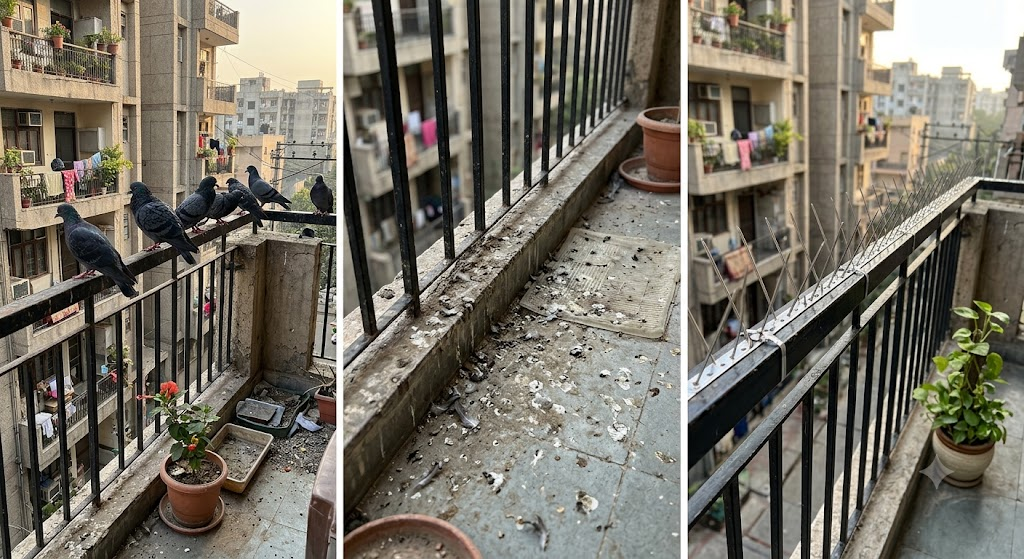
You clap, they fly off. Ten minutes later they’re back on the same railing. You hang an old CD, tie up a plastic bag, maybe even buy a fake owl — works for two days, then the pigeons figure it out and ignore it completely. If this is your balcony, you’re not doing anything wrong. You’re just up against a bird that’s a lot more stubborn than people expect.
Let me explain why pigeons keep coming back, and then the one thing that actually ends it.
Pigeons don’t visit your balcony. They move in.
This is the part most people miss. A pigeon on your railing isn’t passing through — it has decided your balcony is home. Pigeons are fiercely loyal to a location. Once a pair picks a spot to roost or nest, they’ll return to that exact ledge for years, no matter how many times you chase them off. Homing instinct is literally the thing pigeons are famous for.
So every scare trick fails for the same reason: it annoys the bird without changing its mind about the address. The CD spins, the pigeon waits it out. The fake owl never moves, so by the third day it’s just décor.
Why your balcony, specifically
It almost always comes down to three things:
- A flat, undisturbed ledge — railings, parapets, the top of your AC outdoor unit. Pigeons need a stable flat surface to sit and nest on.
- Shelter — a covered balcony, a chajja, the gap behind the AC. Cover from rain, sun and hawks.
- Food or water nearby — grain someone’s put out, open kitchen waste, a neighbour who feeds them. Once there’s a food source in the building, the whole flock treats it as their base.
Here’s the useful bit: you can’t always control the food (your neighbour’s habits aren’t yours to fix), and you can’t remove the shelter without bricking up your own balcony. The one lever you fully control is the flat landing surface. Take that away, and the pigeon has nowhere to sit — and a pigeon that can’t land can’t roost or nest.
What doesn’t work (so you can stop wasting money)
An honest list, because we’ve had customers try every one of these before calling us:
- Reflective CDs and tapes — short-lived at best
- Fake owls, rubber snakes, plastic crows — pigeons get used to them within days
- Gel repellents — messy, collect dust, need re-applying, and can trap smaller birds
- Ultrasonic “repeller” gadgets — little to no real effect on pigeons
- Naphthalene balls, chilli, spices — wash away and fade fast
None of them change the one thing that matters: the comfortable place to land.
What actually works: take away the perch
Bird spikes work because they don’t try to scare the pigeon — they make the surface impossible to stand on. No flat spot, no roost. The bird tries once, finds nowhere to grip, and goes off to find an easier building. It isn’t painful; the spikes are blunt deterrents, which is exactly why the same system is used at metro stations and heritage buildings across the country.
For a balcony, you’d usually spike:
- The railing top — their favourite landing strip
- The AC outdoor unit, if it’s out there
- Any parapet or wide ledge
- The chajja or sunshade above, if they perch up there
Most balconies need spikes in two or three of these spots, not just one. If you only spike the railing, the flock simply shifts to the parapet. Cover the obvious perches together and they give up on the whole balcony.
One realistic warning
If the pigeons have already built a nest with eggs or chicks, don’t install spikes over an active nest. Disturbing eggs is both unkind and, for some species, legally grey in India. Wait for the chicks to fly off (or have the nest removed properly), clean the area thoroughly, then spike it so they can’t rebuild in the same spot.
The bottom line
Pigeons keep coming back because they’ve chosen your balcony as home, and no amount of shooing changes their mind. The only lasting fix is to remove the flat landing surfaces so there’s simply nothing to come back to. Do it properly once, and the problem isn’t managed — it’s over.
If you want UV-protected bird spikes built for Delhi weather — the same ones the DMRC and Mahindra use — send us a quick photo of your balcony on WhatsApp. We’ll point out exactly which spots to cover and how many strips you’ll need.
📲 WhatsApp us a photo of your balcony → · +91 99908 00532 🌐 sumitraplastics.com · ✉️ contactus@sumitraplastics.com 📍 B-11, Mayapuri Industrial Area, Phase 1, New Delhi – 110064 · Mon–Sat, 9 AM–6 PM